

At major printing exhibitions, visitors are often drawn to speed demonstrations. Machines running at high throughput attract attention, while technical specifications fill brochures and presentation screens.
Yet inside production facilities, conversations tend to focus on a different issue.
Color accuracy.
Particularly red.
Many print providers discover the problem only after receiving a demanding brand project. A corporate logo that looks acceptable on screen suddenly appears slightly orange on fabric. A promotional banner printed in two different production batches no longer matches perfectly. Exhibition graphics installed side by side reveal subtle but noticeable color variations.
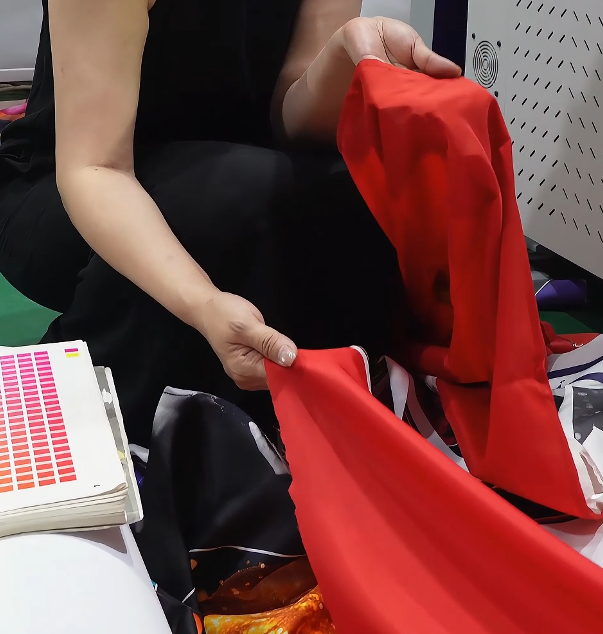
These situations may seem minor, but in commercial printing environments, they can influence customer satisfaction, reprint rates, and overall project profitability.
As brand owners become increasingly sensitive to color consistency, accurate red reproduction has become an important performance indicator for any modern sublimation printer.
Red occupies a unique position in visual communication.
It is widely used in:
Unlike many neutral colors, slight changes in red tones are immediately visible to the human eye.
A red that shifts toward orange can dramatically alter the appearance of a brand logo. A deep crimson that loses saturation may appear faded or less premium.
For print service providers working with color-sensitive customers, maintaining accurate red output is not simply a technical objective—it is a business requirement.
Many conventional systems rely on standard four-color configurations.
While these setups remain effective for numerous applications, challenges can emerge when printing highly saturated colors or smooth gradients.
Common issues include:
These limitations become more visible when producing large-format graphics, flags, soft signage, and exhibition displays.
Historically, equipment investment decisions focused heavily on production speed.
Today, however, printing companies face more complex challenges.
Growing labor costs, shorter delivery windows, and increasing quality expectations are forcing manufacturers to evaluate their entire production workflow.
A machine that produces graphics quickly but requires frequent color adjustments can become a bottleneck.
This is one reason the dual head sublimation system has gained momentum across multiple markets.
By combining productivity with improved process control, dual head platforms are helping facilities achieve better scalability without sacrificing output quality.
The widespread adoption of the Epson I3200 printhead has accelerated this transition.
Industrial users value the platform because it supports:
When integrated into a dye sublimation dual spray printer, these printheads enable both productivity and precision.
This combination is particularly valuable for facilities handling commercial textile graphics and advertising materials.
One of the most important advantages of modern multi-color sublimation systems is expanded color gamut coverage.
In practical terms, this means the printer can reproduce a wider range of colors more accurately.
For red-intensive designs, expanded gamut coverage helps reduce:
The result is a closer match between digital artwork and final printed output.
This improvement becomes especially noticeable in corporate branding projects where precise color matching is required.
Commercial graphics increasingly incorporate complex visual effects.
Designers frequently use:
These elements require smooth tonal transitions.
Poor gradient handling can create visible banding or graininess, particularly in red and dark color regions.
Modern industrial sublimation printer configurations are increasingly optimized to maintain smooth transitions even during high speed sublimation production.
For production facilities, this means fewer rejected prints and improved customer confidence.
The printing market has changed significantly over the last decade.
Factories are processing:
This trend has increased demand for scalable production systems.
A printer that performs well during short demonstrations may encounter difficulties during long production cycles.
As a result, buyers increasingly evaluate:
The ability to maintain color accuracy throughout extended production periods is becoming a critical competitive advantage.
Many facilities discover that their primary challenge is not maximum speed but workflow interruptions.
Frequent recalibration, color correction, and maintenance activities can reduce overall output.
A well-designed dual head sublimation system helps minimize these interruptions by supporting a more stable industrial printing workflow.
This contributes to:
Several years ago, buyers typically focused on hardware specifications.
Today, purchasing discussions increasingly revolve around operational outcomes.
Decision makers want to understand:
As commercial graphics become more brand-driven, color consistency is emerging as a strategic differentiator.
The ability to reproduce red accurately is no longer simply a technical achievement. It reflects the overall maturity of the printing platform.
Industry observers expect future competition among sublimation printer manufacturers to center around three key factors:
Facilities that successfully balance these elements will be better positioned to meet evolving market expectations.
Color shifts can occur due to limited color gamut coverage, ink configuration, color profiling, and printer calibration settings.
No. While productivity improves, many users also benefit from enhanced color consistency, workflow efficiency, and production stability.
The printhead is known for its precision, reliability, and ability to support continuous industrial production environments.
Yes. Better color consistency reduces reprints, lowers waste, and improves customer satisfaction, all of which contribute to profitability.
Retail branding, exhibition graphics, banner production, sports graphics, corporate identity projects, and textile decoration frequently require precise red color matching.
Reliability, maintenance requirements, workflow efficiency, print consistency, color accuracy, and scalability are often more important than headline speed figures alone.