

In industrial printing environments, productivity is often determined by details. While printheads, ink systems, and software receive most of the attention, mechanical components also play a critical role in overall equipment performance.
Modern dye sublimation dual spray printers are designed for high-volume production, where even a few minutes of downtime can affect delivery schedules and profitability. To improve reliability and simplify maintenance, many manufacturers are upgrading their hot cutter systems from traditional clamp-based fixation to a screw-tightening structure.
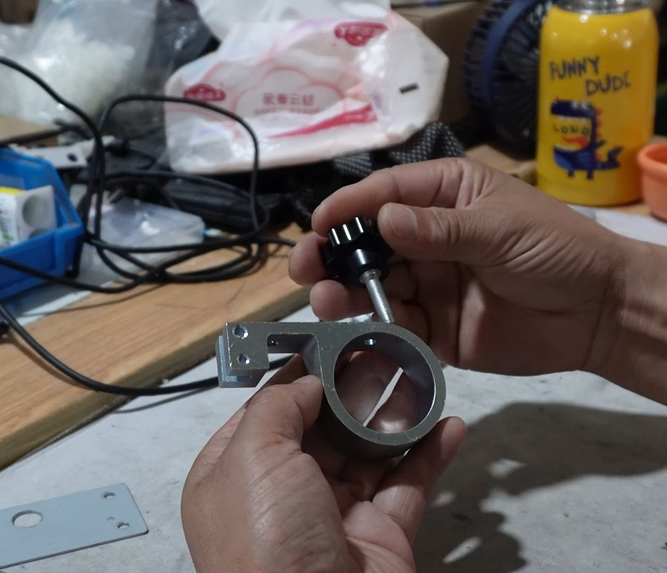
Although this modification appears simple, it offers significant advantages for industrial users seeking higher efficiency and lower maintenance costs.
The hot cutter is responsible for material separation and finishing during production.
Whether printing:
the cutting system must operate consistently throughout long production cycles.
A weak fixation structure can lead to:
For an industrial dye sublimation printer, these issues directly impact production efficiency.
For many years, clamp fixing was widely used because of its simplicity.
However, under continuous industrial operation, several limitations became apparent.
Operators often need additional steps when replacing or adjusting cutter components.
Repeated vibration during production may gradually reduce fixation strength.
Technicians usually spend more time performing routine maintenance and alignment.
As production volumes continue to grow, manufacturers are seeking more efficient alternatives.
The upgraded screw-tightening mechanism addresses many of these challenges.
Maintenance personnel can quickly secure or replace cutter components with fewer adjustment steps.
A more secure fixation method helps maintain alignment during extended operation.
Industrial printing environments require consistent performance over long production periods.
The upgraded structure helps reduce unwanted movement and improves operational reliability.
Today's high speed sublimation printing machines are expected to operate continuously for extended periods.
Production facilities often run:
In such environments, equipment reliability becomes a key performance indicator.
A hot cutter upgrade contributes to smoother workflows by reducing maintenance interruptions and improving uptime.
Many modern systems use the Epson I3200 sublimation printer platform due to its balance of speed, precision, and durability.
The Epson I3200 printhead offers:
Fine details and sharp text remain consistent across long print runs.
Accurate color reproduction is essential for branding, advertising, and textile applications.
Smooth transitions improve image quality and customer satisfaction.
When paired with an upgraded cutter system, these advantages contribute to a more complete industrial printing solution.
A dual head sublimation printer is designed to maximize throughput while maintaining print quality.
Compared with single-head systems, dual-head technology provides:
However, achieving these benefits requires all machine components to work together reliably.
Mechanical upgrades such as screw-tightened hot cutters help support the continuous production demands of modern facilities.
When evaluating a commercial sublimation printer, buyers often focus on print speed and image quality.
Equally important are:
The upgraded cutter structure contributes to a better return on investment by minimizing maintenance-related interruptions.
For companies running a continuous sublimation production system, even small efficiency gains can generate substantial savings over time.
A hot cutter separates printed materials efficiently while helping maintain clean edges and production flow.
Screw tightening provides better stability, easier maintenance, and improved long-term reliability.
Indirectly, yes. Improved machine stability supports more consistent production performance.
Absolutely. It is specifically designed to meet the demands of continuous industrial operation.
Yes. Since dual-head systems often run at higher production volumes, reduced downtime becomes even more valuable.
Industrial printing performance depends on both advanced printing technology and thoughtful mechanical engineering. By upgrading the hot cutter fixation method from traditional clamping to screw tightening, manufacturers can improve maintenance efficiency, enhance machine stability, and support long-term continuous production.
For businesses investing in a dye sublimation dual spray printer, these practical improvements help maximize productivity, reduce downtime, and increase overall operational efficiency.