

Traditional cultural symbols such as dragons, phoenixes, and five-color sacred deer contain extremely complex visual structures.
Unlike ordinary graphic patterns, these designs combine:
For industrial textile manufacturers, reproducing these elements consistently is not a design problem. It is a process control problem.
Many factories can produce one perfect sample. The real challenge is maintaining the same quality after thousands of square meters of continuous production.
This is where a professional dye sublimation dual spray printer becomes a critical production tool rather than a simple printing machine.
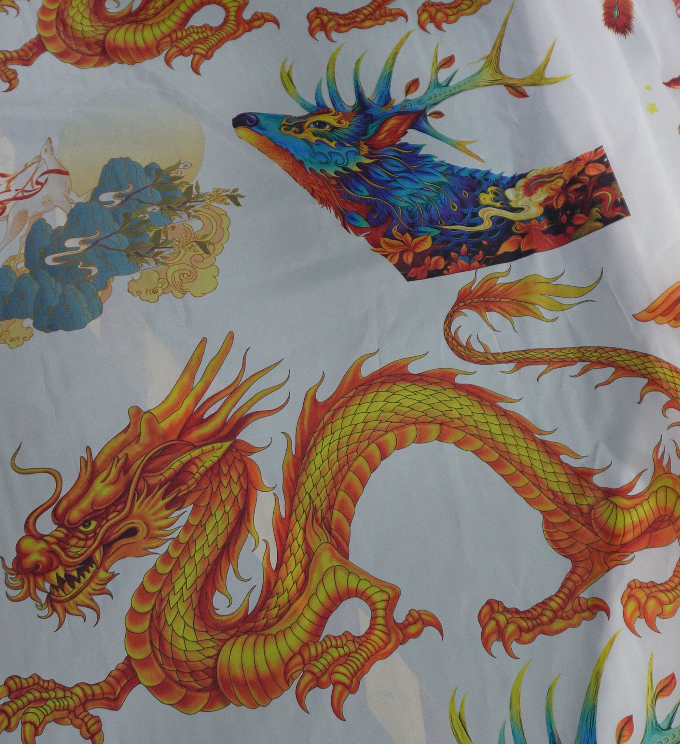
A dragon pattern may include hundreds of independent visual layers:
During sublimation transfer, every color transition depends on precise:
A small instability in the printing process can create visible defects:
For factories producing premium cultural textile products, these defects directly reduce product value.
A common misunderstanding is that adding more print heads only improves productivity.
In reality, a professional dual head sublimation printer focuses on synchronized production control.
The system must coordinate:
Without accurate synchronization, high-speed printing can introduce:
The purpose of dual spray architecture is to maintain productivity without sacrificing visual accuracy.
Modern industrial systems often utilize the Epson I3200 sublimation printer platform because print stability depends heavily on microscopic ink control.
The printing process involves controlling:
Each droplet must reach the correct position on the textile surface.
Incorrect droplet placement can cause:
Ink Deposition determines how efficiently color information is converted from digital data into physical textile appearance.
For cultural patterns such as phoenix feathers or deer fur textures, accurate deposition helps maintain:
Many buyers focus on print resolution, but mechanical stability is equally important.
During continuous operation, small mechanical vibrations may affect:
Professional industrial systems require Micro-vibration control technology to reduce unwanted movement during high-frequency operation.
This becomes especially important when printing:
A factory investment should not be evaluated by a single sample.
Industrial evaluation requires:
Stress testing under realistic production conditions.
Testing normally includes:
The equipment operates for extended periods to evaluate:
Different textile structures influence:
A reliable industrial dye sublimation printer should maintain stable output across different polyester-based materials.
For commercial production, the most important measurement is not maximum speed.
It is Yield Rate.
A higher Yield Rate means:
For cultural textile applications, improving Yield Rate requires cooperation between:
A complete textile sublimation printing solution is therefore a system rather than a single machine.
Global textile printing markets are increasingly influenced by environmental regulations.
Industrial buyers are paying more attention to:
Sublimation printing has advantages in many textile applications because the process integrates color into polyester fibers instead of leaving a thick surface ink layer.
For applications requiring certified materials, manufacturers also need to consider:
Fire-retardant compliance
especially for:
A reliable sublimation printer provides more than image output.
It creates production advantages:
Through stable components and optimized maintenance procedures:
Downtime reduction becomes a direct improvement in production efficiency.
Stable equipment allows factories to:
Complex cultural designs can become:
Because they contain complex gradients, fine details, and high-saturation colors that require accurate ink control and stable textile processing.
A dual spray system improves production capability through synchronized printing architecture, making it more suitable for industrial workloads and advanced applications.
Because incorrect ink placement changes color density, edge sharpness, and gradient smoothness.
Because even small mechanical movement can affect registration accuracy during high-resolution continuous printing.
They should evaluate:
The future of cultural textile printing is not defined by who can print a beautiful sample.
It is defined by who can reproduce that quality thousands of times under industrial conditions.
A professional dye sublimation dual spray printer combines precision control, stable Ink Deposition, mechanical accuracy and production reliability.
For global textile manufacturers entering premium cultural printing markets, advanced sublimation technology is becoming the foundation for scalable and profitable production.