

In today's digital textile and advertising industries, image quality has become a key competitive advantage. Customers expect sharp logos, smooth gradients, vibrant colors, and precise detail reproduction. While many people assume image resolution alone determines print quality, the reality is far more complex.
A dye sublimation dual spray printer combines advanced printhead technology, premium sublimation inks, optimized media compatibility, and sophisticated droplet control systems to achieve exceptional print clarity.
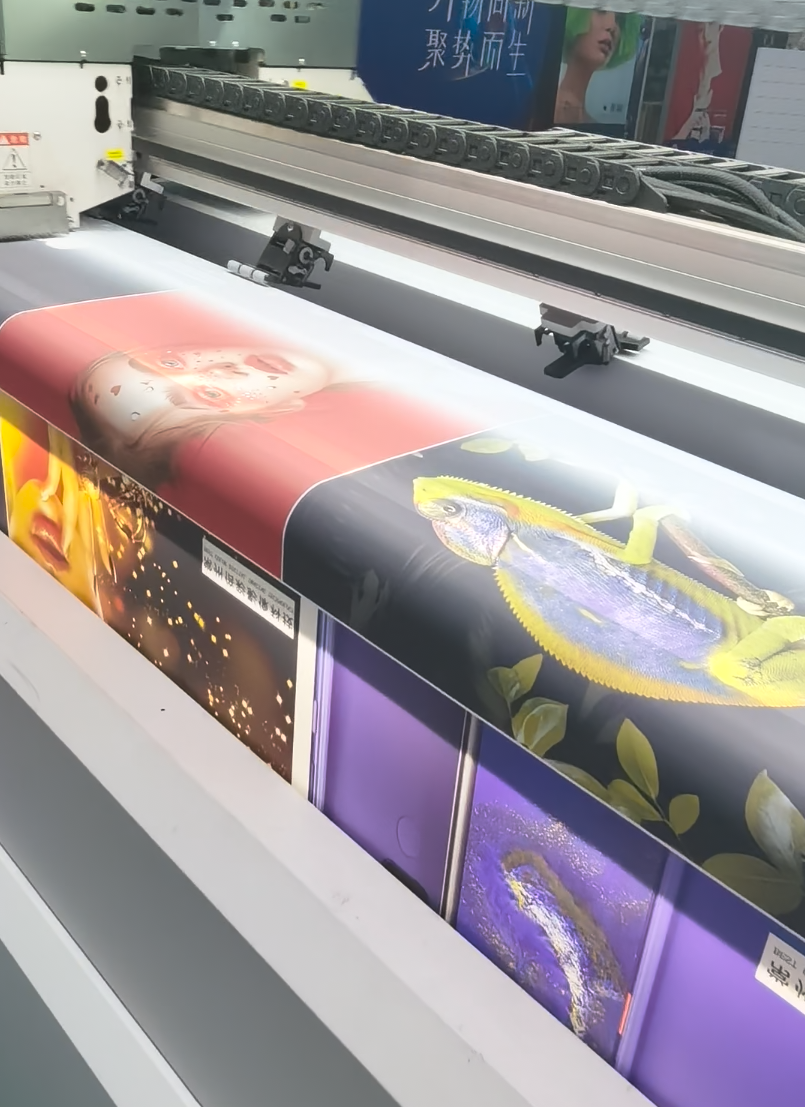
High-resolution artwork is essential for producing quality prints. If the original design lacks sufficient pixel density, even the best printer cannot recreate missing detail.
However, once the artwork meets professional standards, print quality becomes heavily dependent on printer technology, ink formulation, transfer media characteristics, and droplet placement accuracy.
This is where modern dye sublimation dual spray printer technology provides significant advantages.
Sublimation printing works by transferring dye particles from transfer paper into polyester-based materials through heat and pressure.
Because the dye penetrates the fabric fibers rather than sitting on the surface, sublimation produces:
These characteristics make sublimation ideal for advertising graphics, flags, textiles, and exhibition displays.
Many industrial manufacturers rely on Epson I3200 printheads for their balance of speed and precision.
A high precision dual spray sublimation printer equipped with dual Epson I3200 heads can generate extremely accurate droplet placement while maintaining high production speeds.
Advantages include:
This level of precision is particularly important for advertising graphics and branded promotional materials.
Not all sublimation inks perform equally.
Low-grade flag inks may cause excessive ink spread and color migration during printing and transfer. This can reduce image sharpness and create blurry edges.
High-quality advertising-grade sublimation inks offer:
For businesses producing premium graphics, ink selection is often just as important as printer selection.
Transfer papers and printable textiles vary significantly in absorbency and coating quality.
Poor media can cause:
Professional media designed for industrial sublimation printing helps maintain droplet integrity and improve overall print clarity.
Printer architecture also affects image quality.
Vertical spray systems may be suitable for standard production but often provide lower precision at higher speeds.
Angled dual-carriage systems increase productivity but require extremely accurate calibration.
Direct spray technology is widely recognized as one of the most precise approaches because it allows highly accurate droplet positioning and consistent image formation.
This contributes significantly to overall dual head sublimation printing machine performance.
Traditional printing systems often force manufacturers to choose between speed and quality.
A dye sublimation dual spray printer overcomes this limitation through synchronized dual-head operation and advanced motion control systems.
Benefits include:
Achieving exceptional print sharpness requires much more than high-resolution artwork. Ink quality, media selection, printhead technology, and printer architecture all play critical roles. By integrating advanced Epson I3200 printheads, premium sublimation inks, and industrial-grade dual-head technology, a dye sublimation dual spray printer delivers outstanding image quality and production efficiency for modern digital printing businesses.